

What Actually Determines How Long Hotel Lobby Armchairs Last
Let’s talk numbers. A decent hotel lobby sees anywhere from 800 to 2,500 people on a busy day. Now, think about that one armchair by the coffee table. Based on maintenance data from major hotel groups, a single hotel lobby armchair in a prime spot gets sat in 60 to 180 times in a 24-hour period. Do the math: that’s between 22,000 and 65,000 compressions in a single year. This isn’t gentle use. It’s a continuous, high-intensity stress test that exposes every shortcut in materials and construction. If you’re specifying furniture, understanding this brutal arithmetic is the first step to buying an asset, not a recurring expense.
The Four Predictable Breakdowns (And What They Really Cost You)
Walk into any hotel that’s been open a couple of years, and you’ll see the same story. The furniture tells you exactly where the spec sheet fell short.
First, the fabric goes. It starts pilling, or the arms get that shiny, polished look where the color has been worn clean off. This “glazing” isn’t a cleaning issue—it’s a fabric failure. With a residential-grade textile, this can start as early as month 14. It’s the first sign you bought a living room fabric for a commercial lobby.
Next, the seat cushion quits. Guests sink into a permanent dent. That’s not a comfort feature; it’s foam collapse. Low-density foam can’t handle the load, leading to sagging that looks terrible and feels worse. You can’t fluff it out. The core is dead.
Then come the noises. A creak or a wobble means the frame joints are loosening. If you’re unlucky, you might find actual cracks in the solid wood inside. This usually means the wood wasn’t kiln-dried properly. It’s still moving, and the frame is paying the price.
Finally, the hardware fails. Paint chips off metal legs from suitcase hits. Worse, welded joints on cheaper bases can crack or open up. Now you’ve moved from an aesthetics problem to a liability issue. All of these are predictable. They all trace back to a single root cause: specifying for the showroom, not for the war zone of daily check-ins.
The Four Specs That Separate the Lasting from the Lackluster
If you want a durable hotel lobby armchair that doesn’t become next year’s budget headache, your checklist needs four non-negotiable items. This is what moves you from buying furniture to procuring commercial equipment.
Fabric: The Martindale Number is Your Best Friend.
Forget just picking a color. Ask for the Martindale rub count. A nice residential fabric might have 12,000 rubs. For a commercial armchair in a lobby, that’s a joke—it’ll be threadbare in no time. You need contract-grade fabric. Period. The benchmark starts at 40,000 Martindale rubs, and for heavy traffic, 50,000 or above is what you should be looking at. This number is your single best guarantee against looking worn out before the loan is paid off.
Cushion Core: Density is Everything.
Always, always ask about foam density (kg/m³). If you get a blank stare or a number below 40, walk away. That foam will pancake. For a seat that needs to keep its shape and support for years, you need high-resiliency foam with a minimum density of 30 kg/m³. For a premier lobby armchair that utterly refuses to sag, this is paired with an independent pocket spring system. The springs fight the permanent body impression that eventually defeats even good foam.
Frame: It’s All About the Joints.
The hidden frame is the skeleton. It must be kiln-dried hardwood—beech is a common, stable choice. But the magic is in the joinery. Glue and staples fail. Screws alone work loose. You need proper mortise-and-tenon joinery, reinforced with steel brackets and corner blocks. This combination creates a single, rigid unit that can handle people dropping into it at odd angles, year after year, without a squeak.
Finishes: The Devil’s in the Details.
The finish on legs isn’t about color; it’s about armor. Thin paint chips. A thick, powder-coated finish resists scratches, corrosion, and UV light. And every screw, bolt, and glide must be stainless steel. Rust stains bleeding from the bottom of a chair leg are impossible to fix and scream neglect to every observant guest.
Leather, Contract Fabric, or PU? The 5-Year Bill.
The initial price tag is a fantasy. The real cost of a hotel lobby armchair is what you spend over five years on cleaning, repair, and replacement.
| المواد | Upfront Cost | Maintenance & Cleaning | Replacement Cycle | The Brand Image Hit |
|---|---|---|---|---|
| Top-Grain Leather | High | Low (easy to wipe down) | 7+ years (if quality) | High (signals luxury, wear) |
| Contract-Grade Fabric | Medium | Medium (needs professional cleaning) | 5+ years (with right specs) | High (durable, design-rich) |
| Low-Grade PU/Bonded Leather | منخفض | High (cracks hold dirt, unreparable) | 1-3 years (will peel) | Severe (looks cheap, fast) |
Genuine leather is tough and easy to care for, but the initial investment is significant. The real budget-killer is low-quality synthetic (PU). It looks like a steal on the invoice but will almost certainly crack and peel within two years. You’ll be re-upholstering or throwing it out, and guests will notice. For most hotels, investing in high-spec contract fabric offers the smartest balance: proven durability for a commercial seating environment, vast design options, and a total cost of ownership that actually makes sense.
How This Gets Built: A Manufacturer’s Blueprint
For a manufacturer supplying the global hospitality trade, these specs aren’t optional upgrades; they’re the baseline. The process starts with the right materials from the ground up.
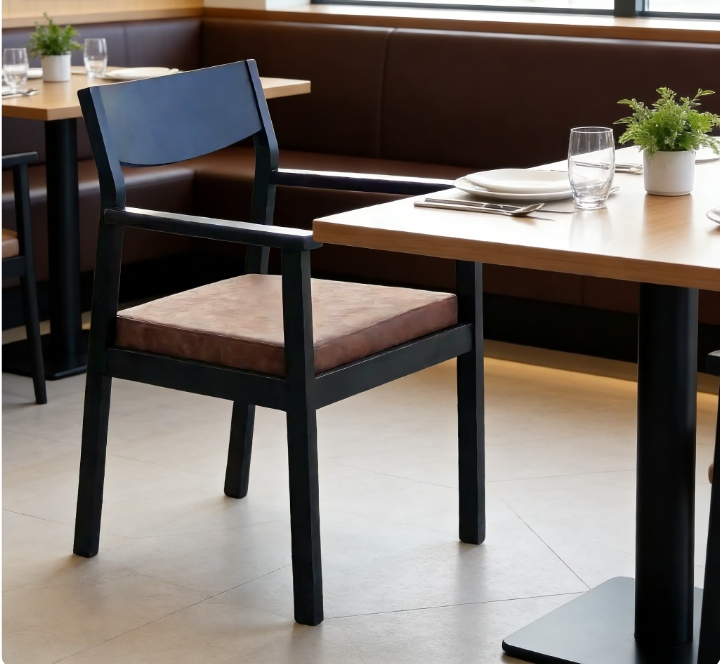
A chair built for this duty uses contract-grade fabrics that meet the 50,000+ Martindale standard as a matter of course. The seat cushion isn’t an afterthought—it’s engineered with high-density foam (55 kg/m³ or above) and often an independent spring system for critical areas. The frame is constructed from kiln-dried hardwood, joined with the reinforced methods that guarantee silent stability.
A company like أثاث الغابات, as a manufacturing and export partner for hotels and rental projects, focuses on this robust, repeatable production process. The product range, spanning solid wood and upholstered items, is built to fulfill a commercial purpose. The capability for OEM/ODM hotel armchair projects means a hotel can specify exact dimensions or provide its own custom hotel furniture fabric, but the underlying architecture that ensures durability remains fixed and reliable.
استنتاج
The lifespan of a hotel lobby armchair isn’t a mystery or a matter of luck. It’s a forgone conclusion written in the specification sheet. It comes down to a simple choice: specify materials and construction that honestly meet the brutal, measurable reality of daily hotel operations, or accept a cycle of visible decline, guest complaints, and premature capital replacement. Investing in the former is how you turn a line item into a long-term, silent contributor to your guest experience and your property’s bottom line.
الأسئلة الشائعة
Q: Is it worth the extra cost to get an armchair with a pocket spring seat?
For a high-profile lobby where first impressions and lasting comfort are critical, absolutely. The pocket spring system works with the high-density foam to prevent the permanent “body dent” and provides superior, consistent support over many years. It significantly extends the comfortable life of the cushion.
Q: We want to use a specific designer fabric. Is that possible with a commercial-grade armchair?
Yes, this is standard. It’s called COM (Customer’s Own Material). A true contract manufacturer will build the frame to commercial standards and upholster it with your fabric. The crucial step is to verify your fabric’s Martindale rub count is suitable for commercial use—otherwise, you’re putting a residential tire on a commercial truck.
Q: What’s the most common mistake in ordering lobby furniture?
Falling in love with the showroom sample without asking how it’s built. Always request the technical specs first: the Martindale count, the foam density, and details on the frame construction and joinery. The right contract furniture for hotels is engineered from the inside out. The aesthetics are important, but they’re the surface of a much deeper foundation.
