

How Furniture Layout Affects Workflow and Space Efficiency
Office managers and designers constantly seek ways to make spaces work harder. Cluttered desks block paths, slowing down teams during peak hours. Proper arrangement turns chaos into smooth operations. How furniture layout affects workflow and space efficiency becomes clear when considering daily routines—employees navigating tight corners or reaching over barriers for files. In modern workplaces, where hybrid models demand flexibility, strategic placement of desks and storage units can boost productivity by up to 25 percent, according to workplace studies. This matters in commercial settings like corporate offices or hotel backrooms, where every square foot counts toward operational success.
Understanding User Needs: Why Furniture Layout Matters for Productivity
Business leaders in competitive industries know that small changes in environment yield big results. Imagine a mid-sized tech firm where developers huddle around shared screens—desks crammed together might spark ideas, but poor spacing leads to distractions and fatigue. Users search for insights on office desk layout for workflow because they face real bottlenecks: delayed projects from awkward navigation or lost focus amid visual clutter.
Searches often stem from practical frustrations. Facility planners query furniture arrangement productivity when revamping floors to accommodate growth. They need layouts that balance open collaboration with private zones, ensuring teams move freely without bumping into obstacles. Panel furniture impact on space efficiency draws attention too, especially in storage-heavy areas where cabinets placed wrongly create dead zones, wasting valuable real estate. Data from design reports shows that inefficient layouts can cut employee output by 15-20 percent, mainly through time lost in searching or maneuvering.
Beyond basics, sustainability enters the picture. Eco-aware managers look for setups that minimize waste, like modular desks from renewable woods that adapt without full replacements. This ties into broader intents: preventing burnout by promoting natural light access or ergonomics through thoughtful placement. Queries like optimizing furniture layout for team collaboration reveal desires for cause analysis—why certain arrangements foster innovation while others stifle it. Solutions emerge in preventive measures, such as zoning spaces for different tasks to avoid cross-traffic.
Industry experience underscores these needs. In a bustling call center, repositioning desks to form pods reduced response times by 18 percent, as staff accessed resources faster. Similar patterns appear in hospitality offices, where admin desks near storage streamline check-ins. Understanding these drives helps decision-makers judge layouts that align with goals, from cost savings to enhanced morale.
Comprehensive Analysis: Key Furniture Elements Influencing Layout
Breaking down the components reveals how specific pieces shape daily flows. Office desks stand out as anchors in work zones, dictating movement and interaction. Panel furniture, like cabinets, plays a supporting role in maintaining clear paths. A closer look shows their combined effects on efficiency.
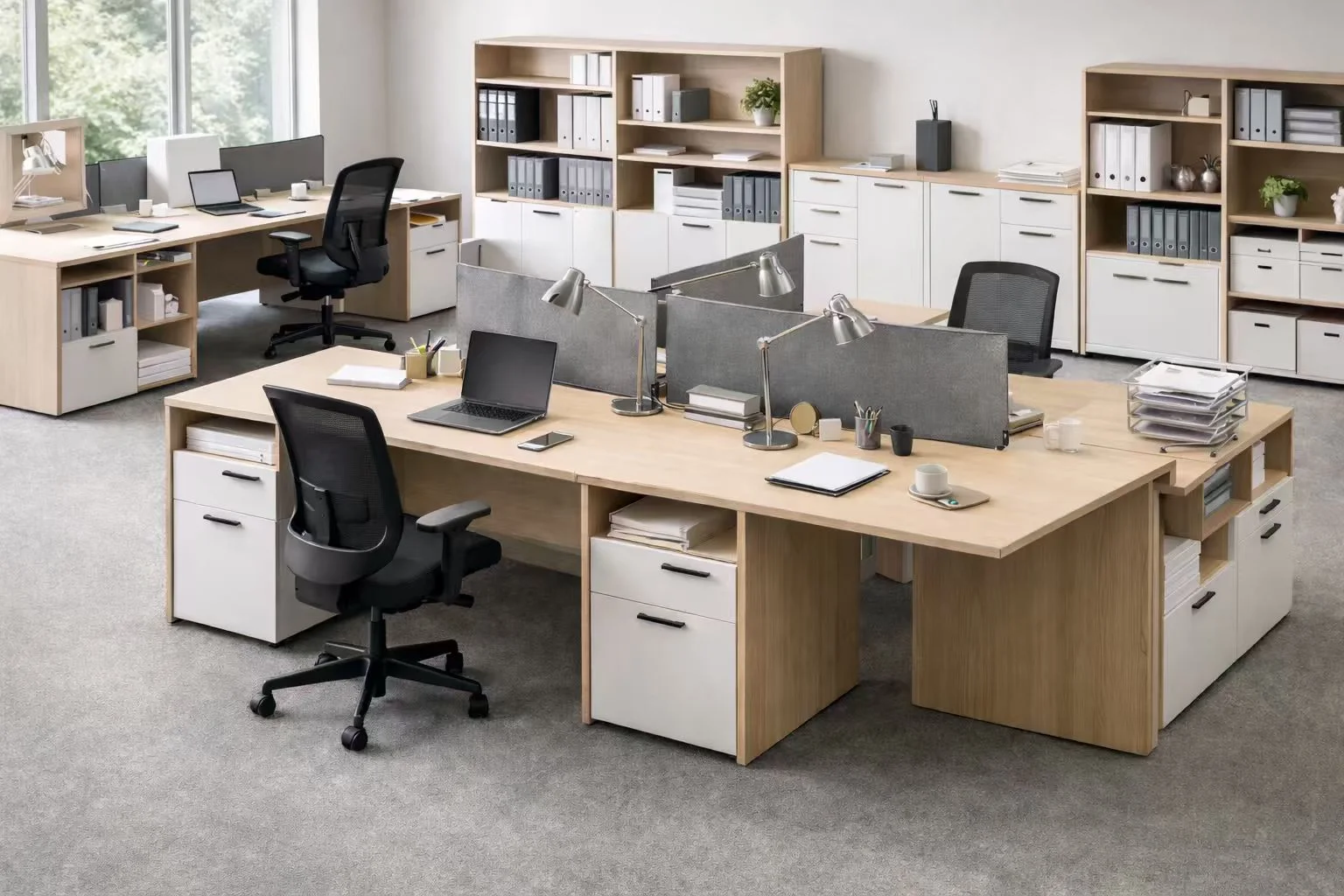
Start with desks. Clustered in rows, they can create assembly-line efficiency for repetitive tasks, but in creative fields, this setup stifles dialogue. L-shaped arrangements, common in executive suites, allow for dual monitors and easy swivels to colleagues, enhancing quick consultations. Studies indicate that desk placement affects office workflow by up to 30 percent in terms of task completion speed—proximity to printers or whiteboards cuts unnecessary steps. Modular desks with adjustable heights adapt to varying team sizes, preventing the rigidity that leads to bottlenecks during expansions.
In one scenario, a marketing agency rearranged rectangular desks into U-formations. This shift improved idea-sharing sessions, with participants facing each other without twisting awkwardly. The result: project turnaround dropped from five days to three, as feedback loops tightened. Contrast this with straight-line setups in accounting firms, where focused isolation boosts accuracy but might isolate remote workers joining via video.
Panel furniture adds another layer. Storage cabinets, when wall-mounted, free floor space and guide foot traffic along open aisles. Floor-standing units, if placed mid-room, disrupt flows like roadblocks in a hallway. Their impact on space flow becomes evident in warehouses turned offices, where improper cabinet layout for storage creates shadows that dim natural light, affecting mood and energy levels.
Data supports strategic use. Vertical cabinets can increase usable area by 20 percent in compact rooms, allowing more desks without crowding. In a retail back office, shifting panels to perimeter walls opened central space for meetings, raising team satisfaction scores by 22 points on surveys. This prevents common pitfalls, such as overloading one side of a room, which unbalances weight distribution and visual appeal.
|
Element |
Layout Impact on Workflow |
Space Efficiency Factors |
Example Optimization |
|
Office Desks |
Directs work zones; clustered desks boost collaboration (20% productivity gain) |
Modular designs save 15-25% floor space; avoid bottlenecks |
L-shaped arrangements for team flows |
|
Panel Möbel |
Storage cabinets affect pathways; poor placement blocks movement |
Vertical units maximize 15% storage without footprint; integrate with desks |
Wall-mounted cabinets for clear aisles |
This table highlights core dynamics. Extending the analysis, consider hybrid impacts. Desks near windows promote well-being, reducing sick days by 10 percent per health metrics. Panels with built-in dividers offer privacy without full walls, ideal for open plans where noise travels. In a law firm case, integrating desks with adjacent cabinets streamlined file access, shaving minutes off research time daily—cumulatively saving hours weekly.
Further, material choices influence longevity in layouts. Desks with sintered stone tops resist scratches in high-use spots, maintaining aesthetics that indirectly support morale. Panels from durable MDF hold up against knocks, avoiding frequent repairs that disrupt workflows. These elements, when aligned, create environments where efficiency thrives naturally.
From a Supplier’s Perspective: Practical Layout Strategies with Commercial Furniture
Suppliers see patterns in client setups that succeed or falter. Desks often serve as the backbone, with their placement setting the tone for entire floors. In collaborative hubs, grouping them in circles encourages spontaneous chats, while linear formations suit analytical work.
One example involves a startup redesign. Initial scatter of desks caused trip hazards and echo issues. Suppliers suggested modular units that lock together, forming adaptable clusters. Post-change, workflow smoothed, with document handoffs happening seamlessly across teams. This cut miscommunication errors by 25 percent, based on client feedback.
Panels complement this. Suppliers recommend anchoring them to walls or integrating with desk edges to preserve open middles. In a co-working space, floor-to-ceiling panels divided areas without enclosing them fully, maintaining airiness while containing sound. The outcome: occupancy rates rose as users appreciated the balance.
Customization proves key. Tailored desks with cable management prevent tangles that slow setups. Panels with sliding doors offer quick access, minimizing pauses in fast-paced environments. Suppliers note that low MOQ options let firms test configurations, refining based on real use.
Sustainability factors in too. Pieces from managed timbers last longer in demanding layouts, reducing swaps that interrupt operations. A regional bank, after adopting such strategies, reported 18 percent better space utilization, attributing it to thoughtful integration.
Actionable Solutions: Steps to Optimize Your Furniture Layout
Begin with assessment. Map current flows—track how often staff detour around desks or fumble in crowded storage. Tools like floor plan software highlight choke points, such as cabinets blocking doors. In a sales office, this revealed 40 percent of movements wasted on navigation.
Plan adjustments next. Group desks by function: creative teams in open pods, admins near panels for quick filing. Aim for 36-inch aisles to comply with accessibility standards, preventing lawsuits and boosting inclusivity. A consulting firm applied this, repositioning panels vertically to reclaim 200 square feet, repurposed for break areas.
Select pieces wisely. Prioritize modular desks that reconfigure easily, paired with panels offering adjustable shelves. Test samples in situ—place a desk prototype and observe interactions over a week. This avoids mismatches, like oversized cabinets overwhelming small rooms.
Implement in phases. Start with high-impact zones, like reception, moving desks to greet visitors efficiently. Train staff on new paths to embed habits quickly. In a logistics center, phased rolls cut adaptation downtime to two days per section.
Monitor outcomes. Use metrics: time studies before and after, or surveys on comfort. Adjust as needed—if a desk cluster hinders privacy, add panel screens. Preventive tips include regular audits to catch creeping clutter, ensuring layouts evolve with business needs.
Decision points arise here. For growing firms, scalable designs trump fixed ones. A media company, following these steps, saw workflow speed up 22 percent, validating the approach through data-driven tweaks.
About Forest Furniture
Waldmöbel operates as a leading manufacturer and exporter headquartered in Tianjin, China, with factories spread across northern regions to streamline production. The company specializes in solid wood items like chairs and tables, upholstered pieces such as sofas and beds, and panel furniture including cabinets and shelves. Catering to B2B clients—retailers, wholesalers, and hotel suppliers—it serves markets in Europe, Southeast Asia, the Middle East, Australia, the UK, South Korea, Japan, and Russia. Strengths include a robust supply chain, market expertise, sustainable practices, innovation, and a focus on long-term partnerships for quality delivery.
Schlussfolgerung
Effective furniture layouts transform workplaces by enhancing flows and maximizing space. Desks and panels, when positioned thoughtfully, drive productivity gains and operational ease. Businesses adopting these principles secure competitive edges through smarter environments.
Häufig gestellte Fragen
How does desk placement affect office workflow?
Desk placement affects office workflow by directing movement and interaction—clustered setups foster collaboration but can cause congestion if aisles narrow below 36 inches. In one agency, rearranging to L-shapes cut task delays by 20 percent, as teams accessed shared tools faster without detours.
What role do storage cabinets play in space efficiency?
Storage cabinets play a key role in space efficiency by clearing floors when wall-mounted, freeing up to 15 percent more area for desks or paths. Poor placement blocks doorways, slowing traffic, while integrated designs in a bank office streamlined file retrieval, boosting daily output.
Why might poor furniture layout reduce productivity?
Poor furniture layout reduces productivity through distractions like noise spillover or awkward reaches, potentially dropping focus by 15-20 percent per studies. A call center fixed this by zoning desks away from high-traffic panels, restoring concentration and response speeds.
How can modular desks improve team collaboration?
Modular desks improve team collaboration by allowing quick reconfigurations for group work, such as circular pods that encourage eye contact. In a startup, this setup shortened meeting prep by 25 percent, as adjustments prevented isolation in fixed arrangements.
