

Custom vs Standard Commercial Furniture: A Category-First Playbook
If you manage project procurement long enough, you learn a quiet truth: the hardest furniture problems rarely show up on delivery day. They show up after three months of cleaning cycles, after the fifth team reconfiguration, after the first busy season when every seat gets dragged twice a day. That is why the question custom vs standard commercial furniture isn’t really about style. It’s about how a space behaves under real use, and whether the decisions you made at the quoting stage will still feel reasonable a year later.
A “standard vs custom” debate can also trap buyers in the wrong mindset. It nudges teams toward big, binary choices, when most successful commercial rollouts do something more practical: they customize the categories that create measurable value and standardize the categories that need predictable lead times, consistent replenishment, and stable unit costs. This article uses that category-first approach, then ties it directly to two categories where customization tends to pay off fastest: storage-focused cabinetry and workstation desks.
For context, if you want the broader framework on how commercial spaces age—and why reliability often wins against novelty—start with the pillar guide on commercial furniture solutions. This article is designed as the next step: a more tactical way to decide where customization belongs and how to run it without breaking schedules.
Why “custom vs standard” fails as a simple decision
In business spaces, furniture has to do more than look presentable in a rendering. It has to tolerate a mix of user behavior you can’t control: staff leaning on drawer fronts, guests placing hot cups on table edges, facilities teams wiping surfaces with stronger cleaners than expected, and frequent re-layouts when headcount changes.
Standard products usually perform well when the environment is stable and repeatable. If you’re rolling out the same private offices across ten floors, standardization can be the smartest move you’ll make. Where teams get burned is assuming the same logic applies to every category. Some categories are “layout-sensitive” and “usage-sensitive” in ways that standard catalogs simply can’t anticipate. That’s where small changes—an adjusted depth, a different cable route, a reinforced edge—save more money than they cost.
The goal is not to chase bespoke furniture for its own sake. The goal is to pay for customization only where it reduces friction: fewer field fixes, less premature replacement, smoother daily operations, and fewer complaints that turn into emergency purchases.
What “standard,” “semi-custom,” and “full custom” really mean in procurement
“Standard” is straightforward: a fixed design, fixed dimensions, and a stable bill of materials. In commercial terms, standard is often synonymous with predictability. Quotes are faster, sample approvals are simpler, and replenishment is easier because the product doesn’t depend on project-specific drawings.
“Semi-custom” is the workhorse of contract procurement. It means starting from an existing, proven structure and modifying the elements that actually matter to the project: dimensions within a controlled range, hole locations for power and data, finish matching, hardware swaps, or configuration changes that don’t require reinventing the entire product. It’s still customization, but it stays inside a manufacturing lane that protects both lead time and consistency.
“Full custom” is where a project introduces new structures, new tooling decisions, or new engineering risk. It can be the right move for signature spaces—front desks, branded focal areas, or unusual footprints—but it also carries the heaviest demands: tighter specification writing, longer sampling cycles, and a more disciplined change-control process.
The practical takeaway is that most commercial buyers don’t need “custom everything.” They need a controlled, repeatable customization method applied to the right categories.
The category-first approach: customize where ROI is real
A category-first approach asks a simple question: which product categories are most likely to clash with your floor plan and operational realities?
Storage and cabinetry typically sit at the top because they have to meet hard constraints. If a cabinet is 30 mm too deep, a corridor can fail accessibility clearance. If a drawer face chips early, a reception area starts to look worn long before you expected. Desks are next because they’re tied to workstation density, cable management, and user comfort, all of which can be undermined by “close enough” dimensions.
By contrast, some categories tolerate standardization well—especially items with fewer interfaces to the building (like loose lounge chairs in low-abuse areas) or items that are easy to replace if they wear faster than desired.
This is why a category-first plan often starts with storage and workstations, then expands outward only if it finds a clear operational payoff.
Where customization usually makes the most sense: panel furniture
When buyers say they want “custom cabinets,” what they often mean is this: they want storage to fit the space without compromises, and they want it to survive daily use without looking tired.
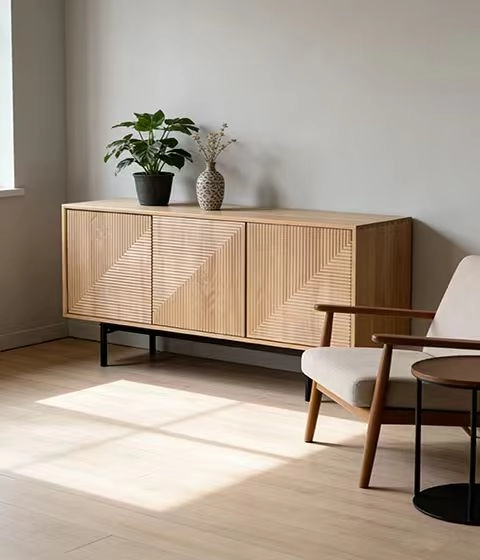
That is precisely why έπιπλα πάνελ is one of the most reliable categories to justify customization in commercial environments. Even modest adjustments can create immediate value because cabinetry and storage live in the collision zone between architecture and behavior: walls that aren’t perfectly square, cleaning crews that move fast, users who overload shelves, and staff who treat drawers as handholds when they’re in a hurry.
Dimensions and clearances are not negotiable in the field
In a hotel back-of-house area, a storage run might be installed between columns with little tolerance. In an office, built-in storage might need to sit under glazing while still allowing HVAC access panels to open. Standard depth and height can be “almost right,” but almost right becomes expensive when installers have to shim, field-cut, or leave gaps that collect dust and look unfinished.
A practical semi-custom approach can adjust depth, toe-kick height, shelf spacing, and door swing logic to match actual constraints. Those changes are not glamorous. They’re also the changes that prevent site rework and the kind of last-minute sourcing that blows up a budget.
Hardware choices are where durability is won or lost
In commercial settings, the cabinet box may survive for years while the hardware becomes the failure point. Hinges drift, drawer slides loosen, and doors start to misalign after repeated use. This is where the buyer’s specification matters. Better slide ratings, more robust hinge systems, and clear acceptance criteria for alignment reduce call-backs and keep the space looking stable.
What many teams miss is that “durability” isn’t only about thickness. It’s about repeatable performance under repetitive motion. A storage wall in a busy co-working floor can easily see hundreds of opens and closes per day. If the hardware isn’t chosen with that reality in mind, the finish won’t matter.
Surface behavior and edge protection matter more than showroom appeal
Cabinetry in public-facing areas gets cleaned constantly. In employee areas, it gets bumped by carts. In both cases, edges are punished. A semi-custom specification that tightens requirements for edge banding quality, corner protection strategy, and surface selection tends to pay off quickly because it prevents the visible “worn” look that can damage perceived property quality.
When procurement teams compare quotes, they often focus on unit price. In reality, the first visible chips and swelling are what trigger replacement discussions. A small up-front investment that delays that moment can shift the total cost of ownership in your favor.
Where customization pays off next: office desks
If panel furniture is the category where buildings force your hand, workstations are the category where users do.
A desk that looks fine in a catalog can fail in daily use because it doesn’t match how people actually work: laptops plus monitors, personal devices, shared docking stations, sometimes sit-stand conversion planning, and the constant need to keep cables from turning into a tangled mess. That’s why office desks are another category where semi-custom changes often produce outsized results without requiring full bespoke development.

Workstation footprint drives density, comfort, and churn
In a mid-size office rollout, a difference of 40–60 mm in desk depth can decide whether you can maintain comfortable circulation while hitting headcount targets. Too shallow, and monitor stands crowd out keyboard space. Too deep, and your aisle widths get tight, which is where safety complaints and facilities headaches start.
Semi-custom desk sizing lets teams align furniture with the actual floor plan rather than forcing the plan to accommodate fixed catalog dimensions. It also supports standardized planning for future expansion. You don’t want to solve density once and then discover you can’t replicate it on the next floor.
Cable management is a procurement issue, not an IT afterthought
Cable routing is where “standard” often fails quietly. If grommet placement doesn’t match the workstation layout, users will route cables over edges, creating clutter and increasing wear. If there’s no plan for under-desk cable trays or clean pass-throughs, facilities teams end up improvising with adhesives and clips that don’t hold up over time.
A desk program that includes defined cutout logic, sensible wire channels, and consistent power placement usually improves the space’s day-to-day usability more than a design upgrade ever could. It’s also the sort of improvement that reduces the small frustrations that cause people to “hack” the furniture in ways that shorten its lifespan.
Stability and assembly method affect long-term satisfaction
Commercial desks get leaned on, bumped, and moved. Even in a “fixed” office, layout changes happen. A desk frame that racks under load becomes a daily annoyance, and the irritation gets louder when people try to write or type.
Semi-custom adjustments—reinforced cross-members, more stable leg geometry, better fastener strategy—can keep a desk program feeling solid without turning it into a heavy, expensive monster. Assembly approach matters too. Knock-down designs can reduce freight costs and simplify installation, but only if the hardware and joints are designed for repeated handling.
A hybrid strategy that keeps budgets and schedules sane
Most commercial programs do best with a split decision: standardize the categories that benefit from stable supply and quick replenishment, then customize the categories that interact most with layout and operations.
A common pattern looks like this. Teams use standard products where replacement is straightforward and the risk of mismatch is low. Then they use semi-custom specifications for storage and desks, because those categories are where small dimensional and functional changes prevent bigger downstream costs. Full custom is reserved for limited, high-impact locations where brand expression or unusual constraints truly demand it.
This hybrid approach also makes stakeholder alignment easier. Finance gets predictable bulk purchasing. Operations gets fewer post-installation complaints. Design still gets control where it matters.
How to run customization without wrecking lead time
Customization becomes expensive when requirements drift. Projects go off-track when drawings change late, finish approvals become open-ended, or sampling isn’t tied to measurable criteria. The fix is discipline, not complexity.
A clean process usually starts with a brief written in operational terms: who uses the furniture, how often, and what would count as failure. Then the project translates those realities into a specification set that can be quoted consistently: key dimensions, material expectations, hardware grades, surface behavior, packaging needs, and what “acceptable” looks like in samples. Once samples are approved, changes should be treated as real schedule events, not casual preferences. That mindset protects your delivery date.
This is where experienced manufacturers matter. A supplier that works with B2B buyers regularly will ask for the right information early—layout logic, usage conditions, and realistic trade-offs—because those inputs are what prevent painful revisions later.
About Forest Furniture
Forest Furniture operates as a furniture manufacturing and export company, with headquarters in Tianjin and factories and production lines across northern China. The model is built around production coordination and consistent quality for international B2B customers, supported by a broad product range that spans solid wood furniture, upholstered furniture, and panel furniture. According to its company profile, the portfolio includes items such as wood chairs and tables, upholstered chairs and beds, lounge seating, sofas and ottomans, as well as panel products like shelves and cabinets, plus related table constructions using materials such as tempered glass and sintered stone tops. If you want the full company background, you can visit the Σχετικά με εμάς page.
Συμπέρασμα
Custom commercial furniture is worth it when it removes predictable friction: when it prevents layout compromises, improves daily usability, and reduces the small failures that trigger expensive replacement cycles. A category-first approach keeps that decision grounded. Start with the categories where buildings and operations apply real pressure—storage-focused panel furniture and workstation desks—then expand customization only where the numbers and the use-case justify it. If you’re building a broader sourcing plan across multiple spaces, revisit the pillar guide on commercial furniture solutions to connect these category decisions to long-term performance in real business environments.
Συχνές Ερωτήσεις
Is custom vs standard commercial furniture a design decision or a procurement decision?
It is both, but procurement usually feels the consequences first. Design drives the intent, while procurement manages lead time, unit cost, and consistency across locations. The most reliable approach is to treat customization as an operational tool: customize the categories where you can measure reduced rework and longer service life, then standardize the rest to protect schedule and replenishment.
When is semi-custom furniture the better choice than full custom?
Semi-custom makes sense when you need specific dimensions, cable routing, or configuration changes, but you do not need a completely new structure. For many projects, semi-custom desks and storage solve the real problems—fit, function, and durability—without the longer sampling cycle and engineering risk that come with full custom development.
Why do panel furniture programs often justify customization faster than other categories?
Panel furniture interfaces directly with architecture, so small mismatches can create big installation issues. Depth, clearance, and door swing logic are hard constraints, not preferences. When those constraints are handled up front through semi-custom specs, buyers often avoid field fixes, visible gaps, and early wear in high-touch zones.
What should I specify first when customizing office desks for a workstation layout?
Start with footprint and cable management. Desk depth and width affect circulation and user comfort, while grommet placement and under-desk routing affect daily usability and long-term cleanliness. Once those are defined, you can refine stability, finish behavior, and assembly method without losing the fundamentals.
How can I reduce lead-time risk on a custom commercial furniture order?
Reduce ambiguity early. Freeze key dimensions, define acceptance criteria for samples, and control changes after approval. A clear specification package and a disciplined review cycle tend to shorten the overall timeline more than rushing the factory at the end, because most delays come from revisions—not production itself.
