

MDF vs Plywood vs Solid Wood for Commercial Furniture 2026 Cost-Lifespan Comparison & Best Choices for HotelsOffices
Specifiers in hospitality procurement and office fit-out projects routinely confront the need to align material expenditures with performance in settings that see relentless daily cycles. Hotel lobbies absorb suitcase impacts and continuous foot traffic, restaurant seating contends with beverage spills plus repeated stacking, office desks bear monitor weights and constant repositioning. Choices between MDF, plywood, and solid wood dictate whether installations remain functional across multiple seasons or demand accelerated turnover.
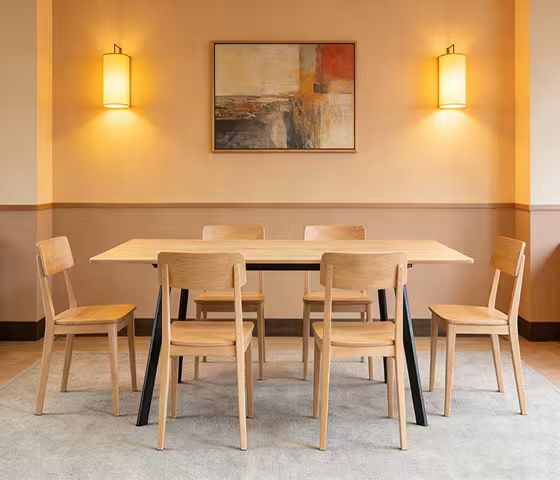
The discussion here remains grounded in commercial-grade demands—hospitality venues, restaurant operations, corporate workspaces—distinct from home use or custom one-offs. Coverage includes observed durability against sustained loading, complete ownership economics incorporating upkeep and service interruptions, application fit within defined high-traffic zones, and methods for integrating materials to secure measured advantages. Experience across hotel chains, dining concepts, and office builds consistently reveals distinct roles for each: targeted combinations regularly achieve extended service while restraining total outlays.
Quick Comparison Table: Key Parameters for Commercial Use
|
Parameter |
MDF |
Plywood |
madera maciza |
Typical Commercial Winner |
|
Initial Cost per sq ft |
Lowest ($1.50–$4) |
Medium ($3–$8) |
Highest ($8–$20+) |
MDF for budget projects |
|
Load-Bearing Strength |
Moderate (prone to sagging under weight) |
High (cross-layered veneers resist flex) |
Highest (natural grain strength) |
Plywood or Solid Wood |
|
Resistencia a la humedad |
Poor (swells quickly with spills) |
Good to excellent (marine-grade options) |
Moderate (requires sealing) |
Plywood |
|
Screw/Nail Holding Power |
Fair (needs reinforcement) |
Excellent (layers grip fasteners well) |
Excellent |
Plywood or Solid Wood |
|
Surface Finish Flexibility |
Superior (smooth, ideal for paint/veneer) |
Good (natural grain or veneer) |
Best (authentic texture) |
MDF for painted/custom looks |
|
Expected Lifespan in Commercial Use |
5–10 years |
10–20 years |
15–40+ years |
Solid Wood for premium settings |
|
Maintenance/Restoration Cost |
Higher (difficult to repair damage) |
Moderado |
Lower (can refinish/sand) |
madera maciza |
|
Environmental Profile |
Moderate (recycled fibers, E0/E1 resins) |
Higher (FSC-certified options common) |
Highest (sustainable sourcing) |
Plywood/Solid Wood |
Data points of this nature underscore the advantage hybrid assemblies hold in varied commercial environments.
Real-World Commercial Scenarios: Where Each Material Performs Best
Hotel Lobbies and Guest Rooms
Pieces in lobbies and guest accommodations encounter guest handling, chemical cleaning, and conditioned-air humidity variation. Presentation value equals structural necessity in these areas.
Solid wood proves effective in upper-segment properties where visible grain communicates refinement. Properly finished oak or rubberwood legs tolerate incidental knocks and respond favorably to periodic refinishing. All-solid construction elevates budgets considerably, limiting deployment in volume-driven or mid-market chains.
Plywood accommodates numerous chain-scale and mid-level hotels. Multi-layer bonding restricts distortion amid climate shifts. Veneer applications simulate solid timber at lighter weight and lower material cost for bulk production runs.
MDF appears routinely in economy-tier specifications. Consistent surfaces accept laminates or pressure veneers replicating marble or hardwood patterns. Accent tables and similar low-load elements perform acceptably with reinforced edge treatments shielding against luggage abrasion or cleaning equipment contact.
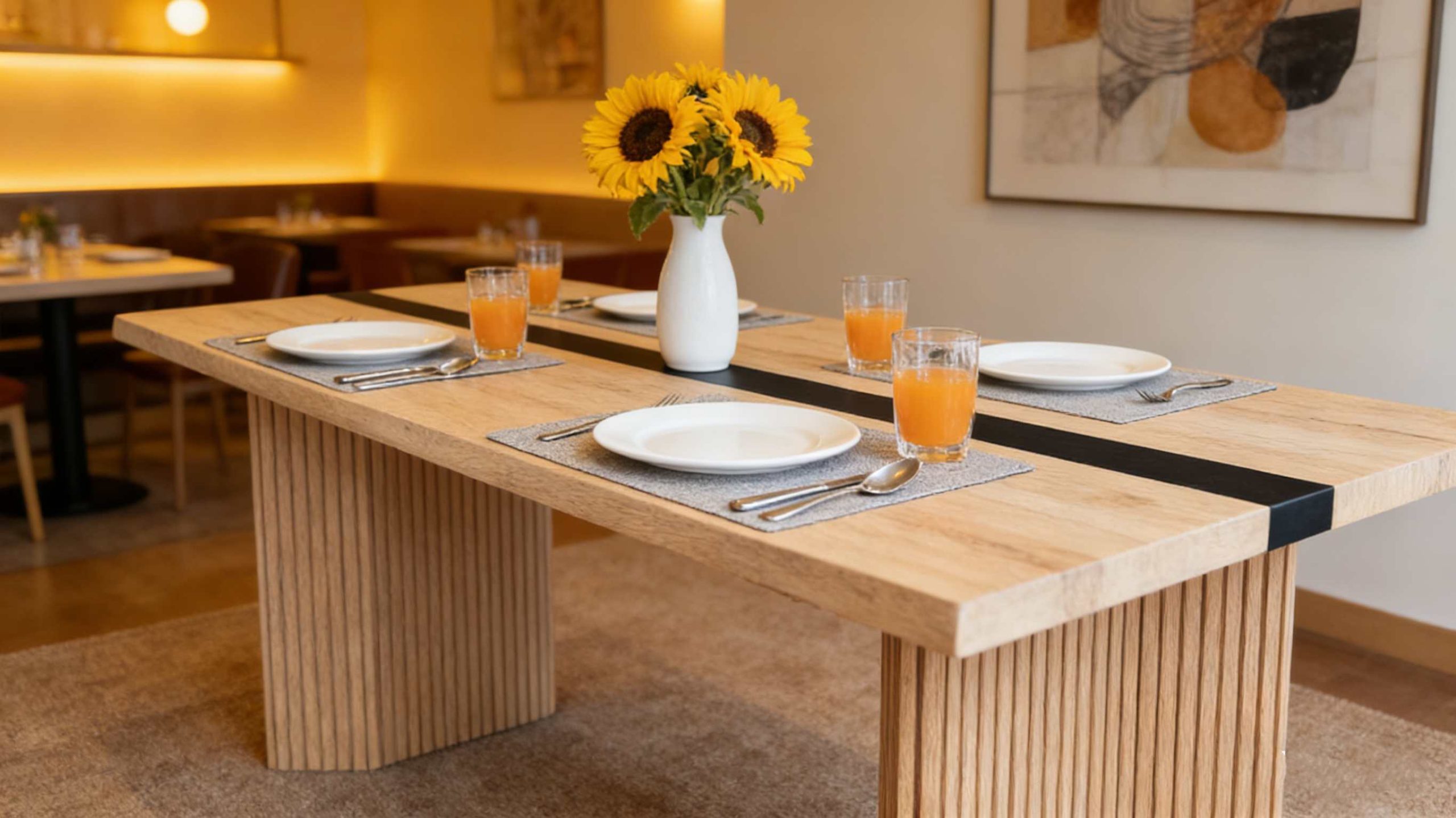
Installed projects frequently integrate: MDF surfaces deliver economical uniformity while solid wood or metal supports furnish required stability. The Xander Modern Rectangular Dining Table for 6-8 illustrates sound practice, its black MDF top combined with a metal base yielding a contemporary form suited to hotel dining or lounge zones at controlled project cost (see Xander Modern Rectangular Dining Table for 6-8 – Black MDF Top & Metal Base).
Restaurant and Café Seating
Chairs and tables in food-service spaces manage liquid exposure, occupant pressure, stacking protocols, and frequent sanitation. Spill tolerance pairs closely with impact endurance.
Plywood assumes primary position in these venues. Commercial formulations withstand beverage or sauce contact without prompt expansion. Layered frames tolerate tens of thousands of seating events yearly.
Solid wood maintains integrity in fine-dining operations. Hardwood species develop desirable aging characteristics, refinishing renewing surface integrity. Higher acquisition pricing corresponds to concepts emphasizing longevity and ambiance.
MDF necessitates rigorous detailing in moisture-prone zones—full sealing together with edge protection remains mandatory. Application extends to booth elements or trim in lower-humidity portions.
Operators commonly pursue composite builds: plywood frames secure foundational strength, upholstered components supply comfort alongside simplified maintenance.
Office and Coworking Desks
Workstations accommodate screen arrays, input devices, and habitual leaning. Rigidity avoids oscillation; work surfaces resist abrasion from standard activity.
Plywood constitutes dependable substructures for office desks. Cross-banded makeup preserves planarity beneath loads and mitigates sag during prolonged periods.
MDF features in expense-conscious workstation layouts. Even faces receive laminates producing sleek uniformity, while attachment zones for hardware gain from supplementary bracing.
Solid wood aligns with leadership offices. Inherent character enriches the setting, provided environmental controls address natural movement.
Composite desks—plywood foundations overlaid with veneer or laminate—furnish workable equilibrium for extensive office implementations.
Bulk Public-Area Furniture
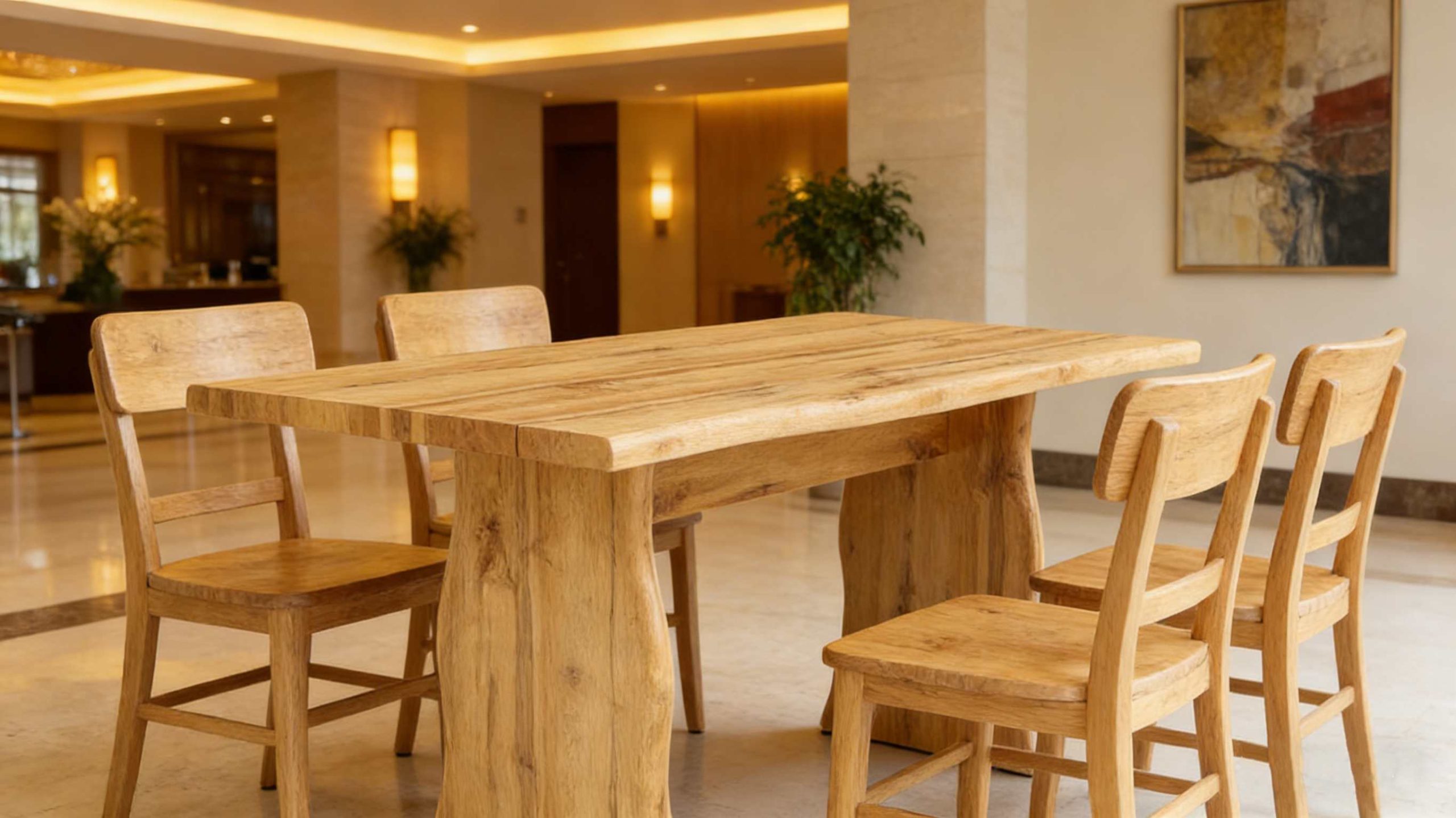
Lounge configurations in transit hubs, waiting zones in healthcare, and retail displays stress minimal operational disruption plus straightforward care.
Plywood and solid wood address impact loads and intensive cycles satisfactorily. Plywood assures predictable behavior; solid wood supports localized rectification.
MDF applies to supplementary functions such as informational panels lacking primary structural duty.
Total Cost of Ownership: Beyond Initial Price
Front-end pricing alone distorts commercial evaluations. Lifecycle summation discloses actual expenditure.
Consider reference 60×36-inch dining table:
- MDF assembly: $180–$300 entry cost. Service duration averages 6–9 years under typical traffic. Annual equivalent approximates $25–$40, compounded by replacement frequency tied to edge compromise or moisture effects.
- Plywood assembly: $350–$550 entry cost. Service duration attains 12–18 years. Annual equivalent reduces to $25–$35 via curtailed maintenance and enhanced serviceability.
- Solid wood assembly: $700–$1,200 entry cost. Service duration covers 20–35 years. Annual equivalent positions at $30–$45, mitigated through refinishing that restores condition.
Plywood generates optimal extended-term economics in the preponderance of intensive applications. MDF presents initial economy yet accumulates superior aggregate costs. Solid wood demonstrates fiscal merit in revenue-sensitive premium contexts where appearance influences patron perception.
Procurement Decision Framework
Utilize this assessment sequence for material review:
- Measure operational intensity (turnover volume, repositioning frequency, cleaning regimen).
- Identify exposure variables (humidity range, spill probability, sanitizer composition).
- Define holding period (transitional assets versus permanent holdings).
- Validate compliance needs (FSC traceability, E1 emissions, applicable fire classifications).
- Secure performance specimens (fastener retention, humidity cycling data).
- Designate composite configurations (MDF finishes supported by plywood or metal elements).
- Confirm supplier credentials in commercial supply chains (alignment with destination regulations).
- Incorporate logistics considerations (production scheduling, volume transport economics).
- Collect service projections from equivalent deployments.
- Establish provisions for commercial-duty endurance.
Cautionary signals include undue reliance on unbraced MDF in primary load paths or lack of substantiation for moisture-resistant variants.
About Forest Furniture
muebles forestales functions as a focused B2B manufacturer and exporter centered in Tianjin, China, with manufacturing operations distributed throughout northern provinces to capitalize on resource proximity and logistical efficiency. Activity centers on wholesale relationships with retailers, distributors, e-commerce furniture operators, and entities equipping hotels plus short-term accommodations.
Range comprises solid wood elements (chairs, tables, coffee tables), upholstered items (chairs, beds, lounge chairs, sofas, ottomans), and panel constructions (shelves, cabinets, MDF tables incorporating tempered glass or sintered stone surfaces). Uniform quality derives from managed manufacturing sequences and persistent design advancement. Forest Furniture directs attention toward dependable, market-responsive offerings that facilitate large-scale commercial procurement and cultivate sustained partnerships.
Conclusión
Material specification for commercial furniture necessitates exact correspondence to operational profiles over designation of an overarching superior class. Plywood recurrently surfaces as the most adaptable selection across moderate-to-intense usage environments, harmonizing structural capacity, moisture accommodation, and realistic lifecycle burdens. MDF contributes dependably within expenditure-constrained endeavors when restricted to ornamental or minimal-stress positions. Solid wood sustains relevance in distinguished installations where aesthetic contribution and protracted endurance counterbalance elevated entry commitments.
Integrated assemblies capitalizing on respective attributes—MDF or veneer exteriors with plywood underpinnings and solid wood accents—consistently produce elevated practical and economic performance. Procurement groups executing comprehensive ownership scrutiny, confirming via operational validation, and partnering with vetted suppliers realize resilient configurations that uphold functional requirements through prolonged durations.
Preguntas frecuentes
Which material lasts longer in high-traffic hotel furniture—MDF, plywood, or solid wood?
Plywood customarily affords 10–20 years of utility in hotel contexts under standard upkeep, outdistancing MDF’s conventional 5–10 years via improved tolerance for mechanical stress and atmospheric moisture. Solid wood often exceeds 20–40 years, though accompanied by amplified maintenance demands and greater procurement outlay.
Is MDF suitable for restaurant tables exposed to spills?
MDF displays susceptibility to fluids without exhaustive sealing measures and edge fortification. Ingress provokes expansion and accelerated decline. Plywood or suitably sealed solid wood administers spill-heavy restaurant conditions with substantially superior consistency.
How to choose between plywood and solid wood for office desks?
Plywood addresses the preponderance of office desks emphasizing bearing capability, dimensional constancy, and budgetary restraint—its stratified architecture opposes distortion under load mass and routine exertion. Solid wood corresponds to executive domains, conferring intrinsic visual richness and refinishing latitude that augment professional ambiance, irrespective of supplementary expenditure.
What is the real cost difference over 10 years for commercial furniture using MDF vs plywood?
MDF regularly curtails preliminary disbursement by 30–50%, nevertheless accelerated renewal owing to attrition inflates 10-year aggregates past plywood in dynamic settings. Plywood’s sustained operational span and attenuated service incidence ordinarily furnish more advantageous overall economics notwithstanding moderate initial disparity.
Can hybrid furniture effectively combine MDF, plywood, and solid wood for hotels?
Hybrid methodologies demonstrate efficacy throughout hotel endeavors—countless executions deploy MDF or veneer tops for refined presentation and cost governance, plywood frames for fundamental robustness, and solid wood legs for supplementary fortitude and aesthetic enhancement. The arrangement concurrently equilibrates fiscal limitations, resilience, and visual merit.
